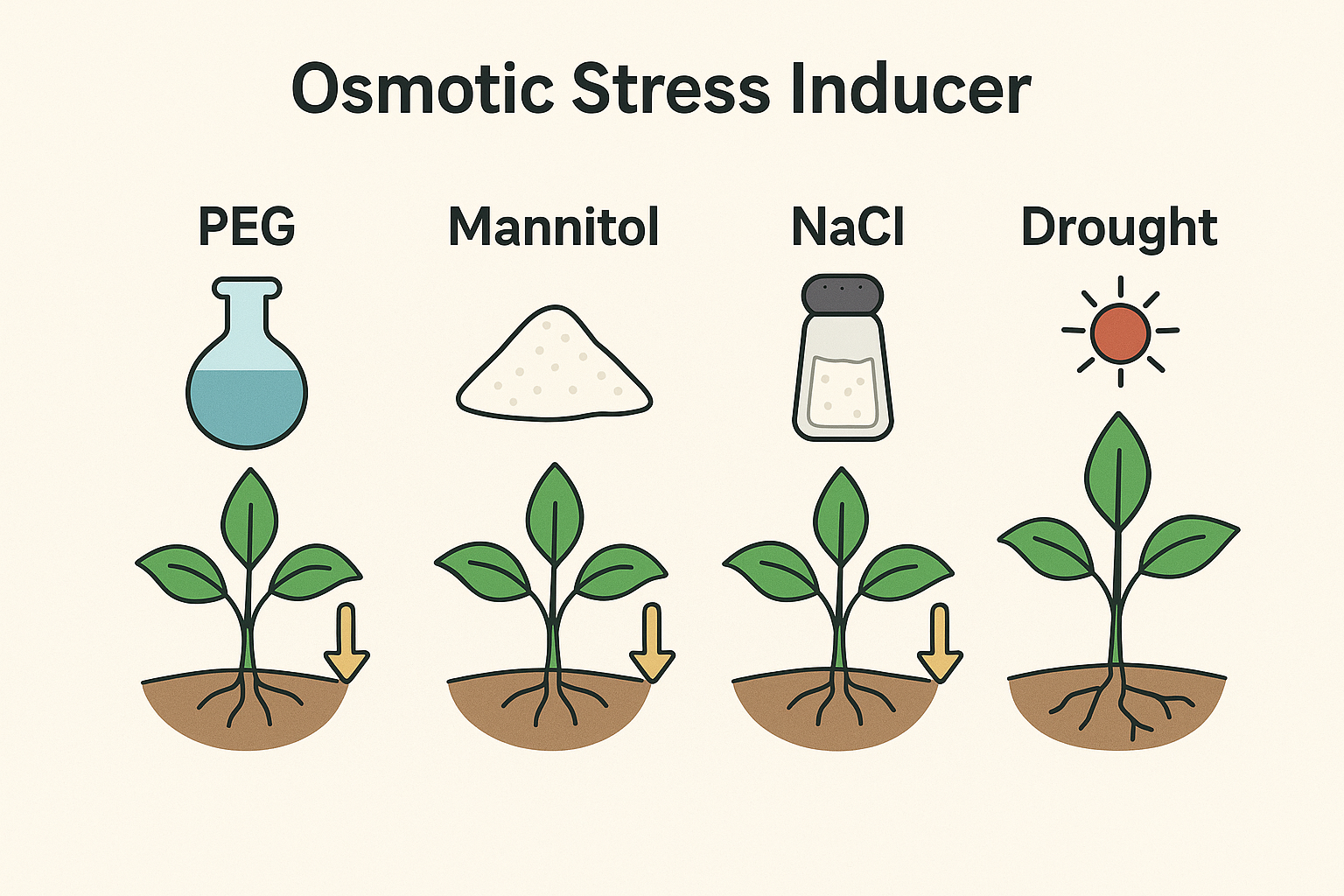
An osmotic stress inducer is any factor (environmental or chemical) that alters the osmotic balance in plant cells, leading to water loss, turgor reduction, or activation of stress-response pathways. These are often used in research to simulate drought, salinity, or dehydration stress, allowing scientists to study plant tolerance mechanisms.
Common Osmotic Stress Inducers:
- Abiotic (Environmental) Inducers
- Drought → causes cellular dehydration.
- Salinity (NaCl, KCl) → increases external osmotic potential, making water uptake harder.
- Freezing → ice formation reduces water availability.
- Chemical Inducers (used in experiments)
- Polyethylene glycol (PEG) → non-penetrating osmoticum, mimics drought by reducing water potential without entering cells.
- Mannitol or Sorbitol → sugar alcohols, create osmotic pressure outside cells.
- NaCl (sodium chloride) → commonly used to mimic salt stress.
Plant Response to Osmotic Stress Inducers:
- Physiological: Stomatal closure, reduced cell expansion, inhibited growth.
- Biochemical: Accumulation of osmolytes (proline, glycine betaine, sugars).
- Molecular: Activation of stress-related genes (e.g., dehydrins, LEA proteins, aquaporins).
- Hormonal: Increased abscisic acid (ABA) signaling triggers protective responses.
Applications:
- Used in plant physiology studies to understand drought/salt tolerance.
- Helps in screening crops for stress-resistant varieties.
- Forms basis for biotechnological approaches (e.g., engineering stress-inducible promoters).