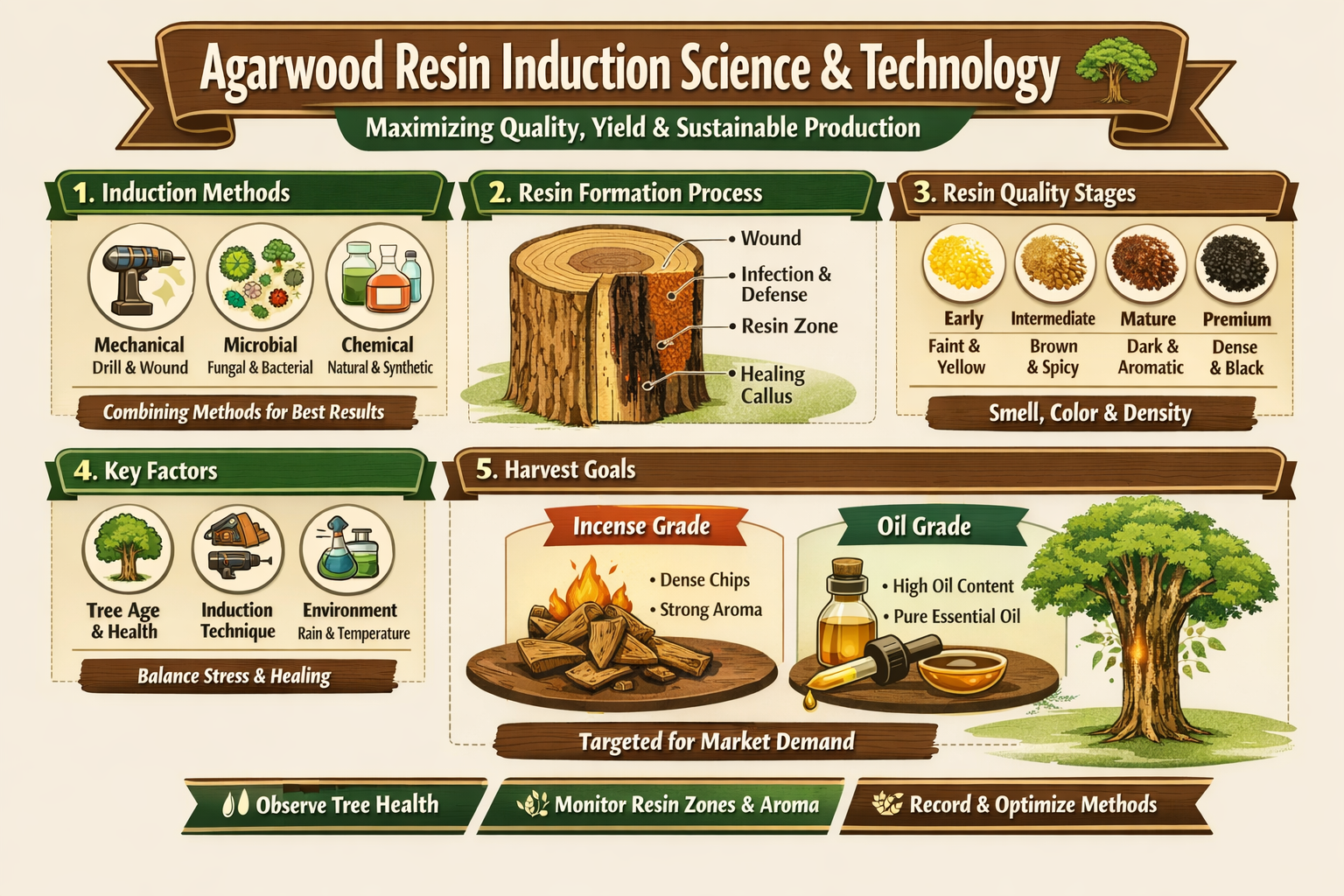
Agarwood has never been a product of chance.
For centuries, the world believed that agarwood was born only in forests, shaped by time, storms, and fate. In truth, agarwood is the result of science hidden inside nature—a tree’s intelligent response to injury, infection, and survival.
The Agarwood Resin Induction Science & Technology Course was created to uncover that hidden science and place it responsibly in human hands.
This course stands at the intersection of tradition and biotechnology, where ancient knowledge of resin formation meets modern understanding of plant defense systems, microbial interactions, and controlled stress responses. It teaches that agarwood resin is not harvested—it is cultivated, guided by precision, patience, and respect for the tree.
At its core, the course redefines resin induction not as an act of force, but as a dialogue with the tree. Through proper wounding, microbial partnership, and time-based monitoring, learners discover how agarwood produces its most valuable compounds—sesquiterpenes and chromones—as protective secondary metabolites. When induction is done correctly, the tree survives, the resin matures, and quality replaces quantity.
This program was designed for those who wish to move beyond trial-and-error practices. It equips farmers, technicians, and professionals with field-ready protocols, ethical induction standards, and market-aligned quality awareness. Participants learn not only how to induce resin, but why resin forms, when to wait, and when to harvest—knowledge that protects both trees and livelihoods.
More than a training, the Agarwood Resin Induction Science & Technology Course is part of a larger mission:
to shift agarwood from destructive extraction to sustainable production,
from illegal trade to compliant, traceable value chains,
and from folklore to verifiable science.
Every graduate of this course becomes a steward of agarwood—someone who understands that true value lies not in how quickly resin is forced, but in how carefully it is guided.
Because in agarwood, the finest fragrance is born from knowledge, restraint, and time.
Tagline: “Decoding Nature’s Alchemy — The Science Behind Sacred Oud.”
Duration: 5–7 Days (40–56 hours) (Lectures + Laboratory + Field Practicum)
Target Participants: Biotechnologists, researchers, foresters, plantation managers, and perfumery technologists
Course Objectives
By the end of this course, participants will be able to:
- Understand resin formation as a plant defense response
- Compare and apply biotic, abiotic, and hybrid induction systems
- Execute field-ready resin induction protocols
- Monitor resin development and optimize yield and quality
- Ensure compliance, sustainability, and commercial viability
MODULE STRUCTURE
Module 1 — Fundamentals of Agarwood Resin Formation
- What resin is (not sap)
- Secondary metabolites: sesquiterpenes & chromones
- Why only stressed/infected trees produce resin
- Wound response vs immune response
- Oxidative stress & resin polymerization
- Vascular blockage and resin zone development
Learning Outcome: Correctly explain why resin forms and where it accumulates
Module 2 — Natural vs Artificial Resin Induction
- Lightning, insects, wind damage
- Natural microbial invasion
- Time scale: 20–50 years
- Mechanical wounding
- Chemical elicitors
- Microbial inoculation
- Integrated / hybrid systems
Case Analysis: Why some induced trees fail to form resin
Module 3 — Abiotic Resin Induction Techniques
- Drilling, nailing, bark removal
- Hole depth, spacing, and orientation
- Salts, acids, oxidizers
- Role of manganese, iron, and stress ions
- Risks of phytotoxicity
- Stress intensity vs resin quality
- Induction intervals
Practical Demo: Proper drilling geometry & spacing
Module 4 — Biotic Resin Induction (Microbial-Based)
- Pathogenic vs endophytic fungi
- Host–pathogen signaling
- Biofilm-assisted resin formation
- Fusarium, Lasiodiplodia, Aspergillus, others
- Monoculture vs consortium inoculants
- Liquid injection
- Solid substrate insertion
- Wound-based inoculation
Lab / Demo: Preparation and application of microbial inoculum
Module 5 – Resin Induction Protocols & Innovations
- Comparative analysis of physical, chemical, and biological induction methods
- Dual-action formulations (e.g., MnO₂ + Fusarium oxysporum blends)
- Factors influencing resin yield and quality
- Protocol optimization for sustainable inoculation and harvest cycles
Outcome: Participants can design and implement optimized resin induction protocols for field use.
Module 6 — Monitoring Resin Development
- Resin zone coloration
- Smell development
- Wood density changes
- 3-month, 6-month, 12-month benchmarks
- Growth-resin trade-offs
- Core sampling
- Increment borers
MODULE 7 — Harvest Readiness & Yield Optimization
- Resin maturity indicators
- Over-harvest vs under-harvest losses
- Tree age & diameter
- Induction density
- Environmental stress
- Healing & regeneration
- Secondary induction cycles
Module 8 — Quality Grading & Market Alignment
- Aroma profile
- Oil content vs wood grade
- Resin distribution uniformity
- Incense-grade vs oil-grade strategies
- Regional preferences (Middle East, East Asia)
- Chemical contamination
- Poor microbial control
Module 9 – Analytical Chemistry & Quality Assessment
- Extraction and identification of volatile compounds (GC-MS, HPLC)
- Quality grading of agarwood resin and oil
- Biochemical markers of high-grade Oud
- Laboratory practical: sampling, extraction, and chromatographic profiling
Outcome: Participants gain laboratory proficiency in agarwood resin analysis and evaluation.
Module 10 – Sustainability, Biosafety & Regulatory Standards
- Environmental biosafety and containment practices
- Bioethical considerations in microbial inoculation
- CITES and national regulations for research and trade
- Integration of ESG principles in biotechnological innovation
Outcome: Participants understand biosafety, ethics, and compliance in agarwood biotechnology.
Module 11 – Capstone Practicum: Field Induction & Data Analysis
Activities:
- On-site resin induction using controlled microbial inoculants
- Data logging of tree response, resin spread, and post-inoculation care
- Analysis and interpretation of induction success metrics
Outcome: Participants gain hands-on mastery of resin induction science from lab to field.
Certification
“Certified Agarwood Resin Induction Specialist (CARIS)”
Issued by Oud Academia, this certification recognizes advanced competence in agarwood tissue culture, microbial induction, and resin analysis.
Key Features
- Hybrid model: lectures, lab training, and field practicum
- Optional certification assessment and internship program
- Ideal preparation for R&D, plantation biotech, and extraction industries