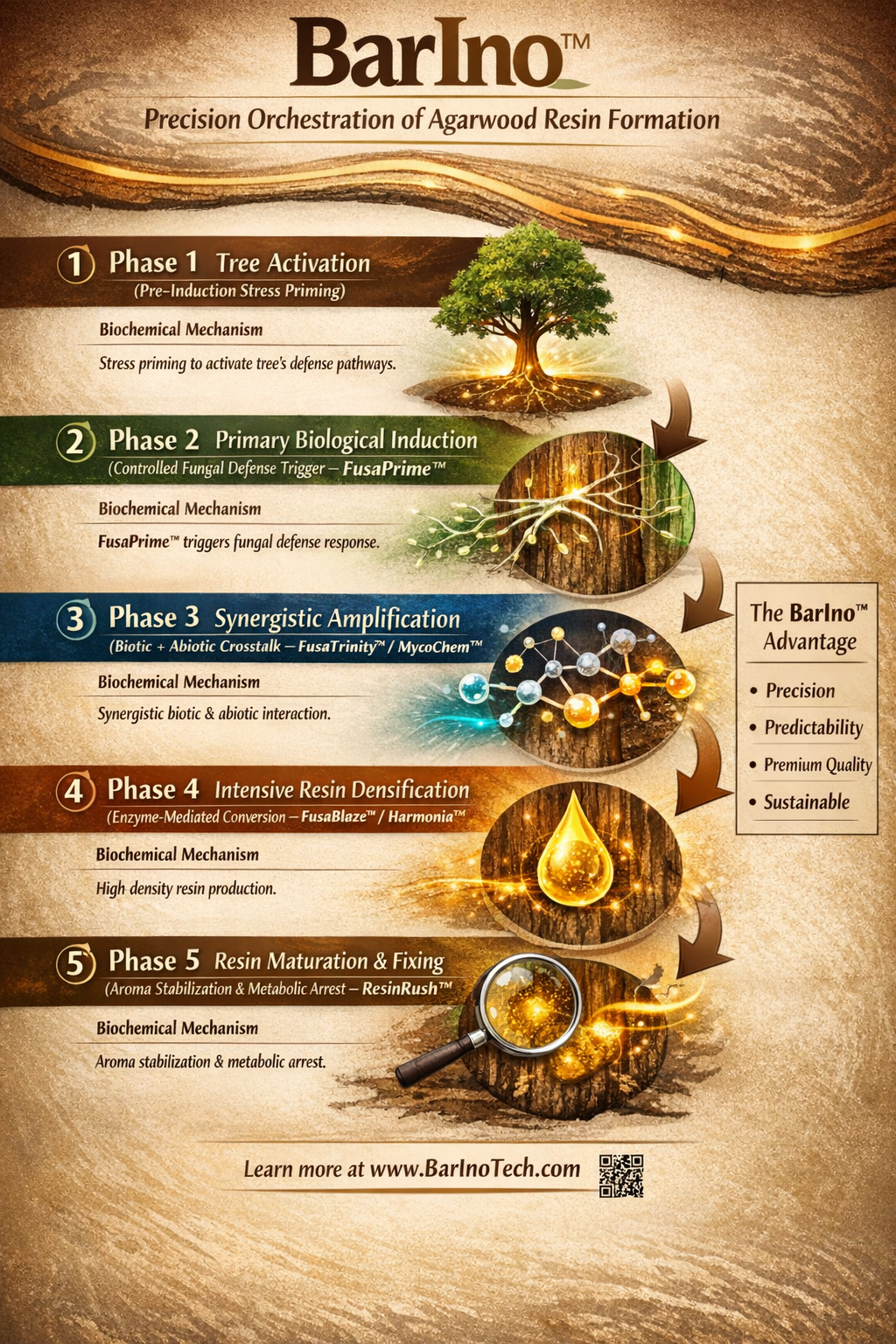
Scientific Justification per Phase – Biochemical & Physiological Basis of the BarIno™ Agarwood Resin Engineering System
Overview: Natural Agarwood Formation (Condensed)
In Aquilaria spp., agarwood resin forms as a defense response to:
- Biotic stress (fungi, microbes)
- Abiotic stress (wounding, drought, oxidative shock)
This activates:
- Phenylpropanoid pathway
- Mevalonate (MVA) & MEP pathways
- Production of sesquiterpenes, chromones, and aromatic phenolics
Natural formation is slow, stochastic, and spatially uneven.
BarIno™ restructures this into a controlled biochemical sequence.
1. Phase 1 — Tree Activation (Pre-Induction Stress Priming) Biochemical Mechanism
- Mild abiotic stress increases:
- Reactive oxygen species (ROS)
- Jasmonic acid (JA)
- Salicylic acid (SA)
- These signals:
- Upregulate defense-related transcription factors
- Increase vascular permeability
- Prime parenchyma cells for secondary metabolism
Crucial insight: Resin production is energy-expensive. Without priming, trees suppress full activation.
Why This Phase Is Necessary
| Without Activation | With Activation |
|---|---|
| Weak fungal colonization | Rapid defense recognition |
| Delayed resin onset | Accelerated pathway activation |
| Patchy response | Systemic readiness |
Analogy: Immune priming before vaccination.
2. Phase 2 — Primary Biological Induction – Controlled Fungal Defense Trigger (FusaPrime™)
Biochemical Mechanism
- Fusarium oxysporum cell wall fragments (chitin, β-glucans):
- Bind to plant PRRs (Pattern Recognition Receptors)
- Trigger PAMP-triggered immunity (PTI)
- Results in:
- Activation of phenylalanine ammonia-lyase (PAL)
- Increased lignin & phenolic deposition
- Initiation of sesquiterpene synthesis
This is the TRUE start of agarwood resin formation.
Why Precision Matters
| Random Infection | FusaPrime™ |
|---|---|
| Uncontrolled necrosis | Localized defense zones |
| Carbon loss | Carbon redirected to resin |
| Tree mortality risk | High survival |
Key concept: Localized biotic stress → localized resin initiation.
3. Phase 3 — Synergistic Amplification – Biotic + Abiotic Crosstalk (FusaTrinity™ / MycoChem™) – Biochemical Mechanism
- Secondary abiotic cues:
- Elevate ROS transiently
- Reinforce JA/ET signaling
- This:
- Amplifies expression of terpene synthase (TPS) genes
- Increases flux through MVA pathway
- Expands resin beyond the initial infection zone
Synergy principle: Biotic stress sets the target, abiotic stress increases intensity.
Why This Is a Breakthrough
- Prior art uses either biology or chemistry
- BarIno™ uses temporal crosstalk
- Produces non-linear (synergistic) resin gain
Comparable to booster immunization after antigen exposure.
4. Phase 4 — Intensive Resin Densification Enzyme-Mediated Biochemical Conversion – (FusaBlaze™ / Harmonia™) – Biochemical Mechanism
- Enzymes partially degrade:
- Cellulose
- Hemicellulose
- Effects:
- Increases intercellular space
- Allows resin migration & pooling
- Enhances oil concentration per unit volume
Additionally:
- Sustained PAL & TPS activity
- Reduced carbohydrate competition
Key outcome: Higher oil percentage, not just darker wood.
Why Color ≠ Quality
| Chemical Induction | Enzyme Densification |
|---|---|
| Fast discoloration | True resin concentration |
| Low aroma depth | Complex sesquiterpenes |
| Sharp oil notes | Rounded, aged profiles |
Densification is biochemical, not cosmetic.
5. Phase 5 — Resin Maturation & Fixing – Aroma Stabilization & Metabolic Arrest (ResinRush™) – Biochemical Mechanism
- Late-stage modulation:
- Downregulates excessive ROS
- Limits over-oxidation
- Stabilizes:
- Oxygenated sesquiterpenes
- Chromone derivatives
- Prevents:
- Volatile loss
- “Green” or acidic aroma notes
This mimics 10–20 years of natural aging in vivo.
Why This Phase Is Unique
- No known induction system controls aroma biochemistry
- Industry assumes aroma improves only post-harvest
BarIno™ matures aroma while resin is still biologically active.
6. Integrated Biochemical Cascade (Summary)
Stress Priming
   ↓
PTI Activation (PAL ↑)
   ↓
Terpene Pathway Amplification (TPS ↑)
   ↓
Resin Migration & Concentration
   ↓
Aroma Stabilization & Fixing
Each phase depends on the previous one — removing any phase reduces efficiency.
7. Comparative Scientific Advantage
| Feature | BarIno™ | Global Competitors |
|---|---|---|
| Hormonal priming | ✅ | ❌ |
| PTI targeting | ✅ | ⚠️ |
| Pathway amplification | ✅ | ❌ |
| Enzymatic densification | ✅ | ❌ |
| In vivo aroma control | ✅ | ❌ |
8. Scientific Takeaway (PhD / Patent-Ready)
BarIno™ does not force resin formation. It guides the plant’s own defense biochemistry through a sequenced cascade of signaling, metabolism, and stabilization.
This converts agarwood from a chance defense artifact into a controlled secondary metabolite system.