
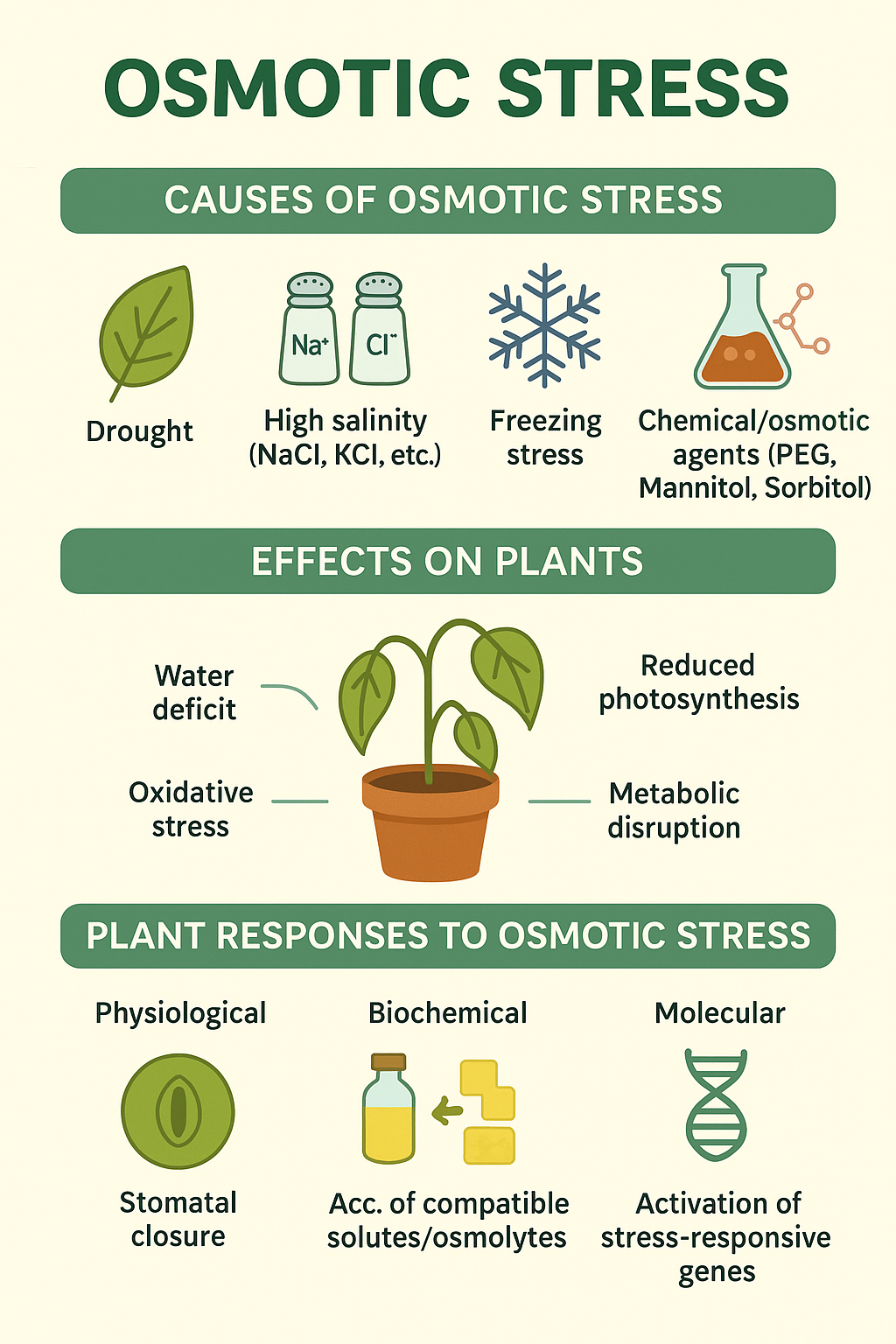
Osmotic Stress in Plants happens when there is an imbalance between the water potential inside the plant cells and the surrounding environment. This reduces the plant’s ability to take up water, leading to physiological and biochemical stress responses.
Causes of Osmotic Stress
- Drought – lack of available water.
- High salinity (NaCl, KCl, etc.) – salts lower external water potential.
- Freezing stress – ice formation decreases liquid water availability.
- Chemical/osmotic agents (PEG, Mannitol, Sorbitol) in experiments.
Effects on Plants
- Water deficit → reduced cell turgor, wilting, growth inhibition.
- Reduced photosynthesis → stomatal closure limits CO₂ uptake.
- Oxidative stress → ROS accumulation damages membranes and proteins.
- Metabolic disruption → impaired enzyme function and nutrient transport.
Plant Responses to Osmotic Stress
- Physiological
- Stomatal closure to reduce water loss.
- Root growth adjustment to seek water.
- Biochemical
- Accumulation of compatible solutes/osmolytes:
- Proline, Glycine betaine, Sugars (sucrose, trehalose).
- Maintain cell turgor and enzyme stability.
- Accumulation of compatible solutes/osmolytes:
- Molecular
- Activation of stress-responsive genes (LEA proteins, dehydrins, aquaporins).
- Hormonal regulation, especially abscisic acid (ABA) signaling.
Importance in Agriculture
- Major constraint in crop productivity under drought and saline soils.
- Studying osmotic stress helps in developing stress-tolerant crop varieties.
- Breeding and biotechnology target osmolyte synthesis and ABA pathways.