Agarwood is not forced—it is elicited.
The BarIno™ Integrated Inoculation System is built on a deep understanding of how Aquilaria trees naturally defend themselves. In the wild, agarwood forms through a slow dialogue between stress, microbes, and time. BarIno™ translates this natural process into a controlled, ethical, and science-guided system.
Rather than relying on a single trigger, BarIno™ uses a phase-based induction approach—activating the tree, guiding biological signaling, balancing fungal colonization, and carefully amplifying resin development. Each step respects tree vitality, cambial health, and long-term productivity, ensuring resin quality improves without sacrificing sustainability.
BarIno™ stands for precision over aggression, biology over brute force, and craft over shortcuts.
It empowers growers to produce high-quality, traceable agarwood while honoring the living system that creates it.
BarIno™ — where science guides nature, and nature rewards patience.
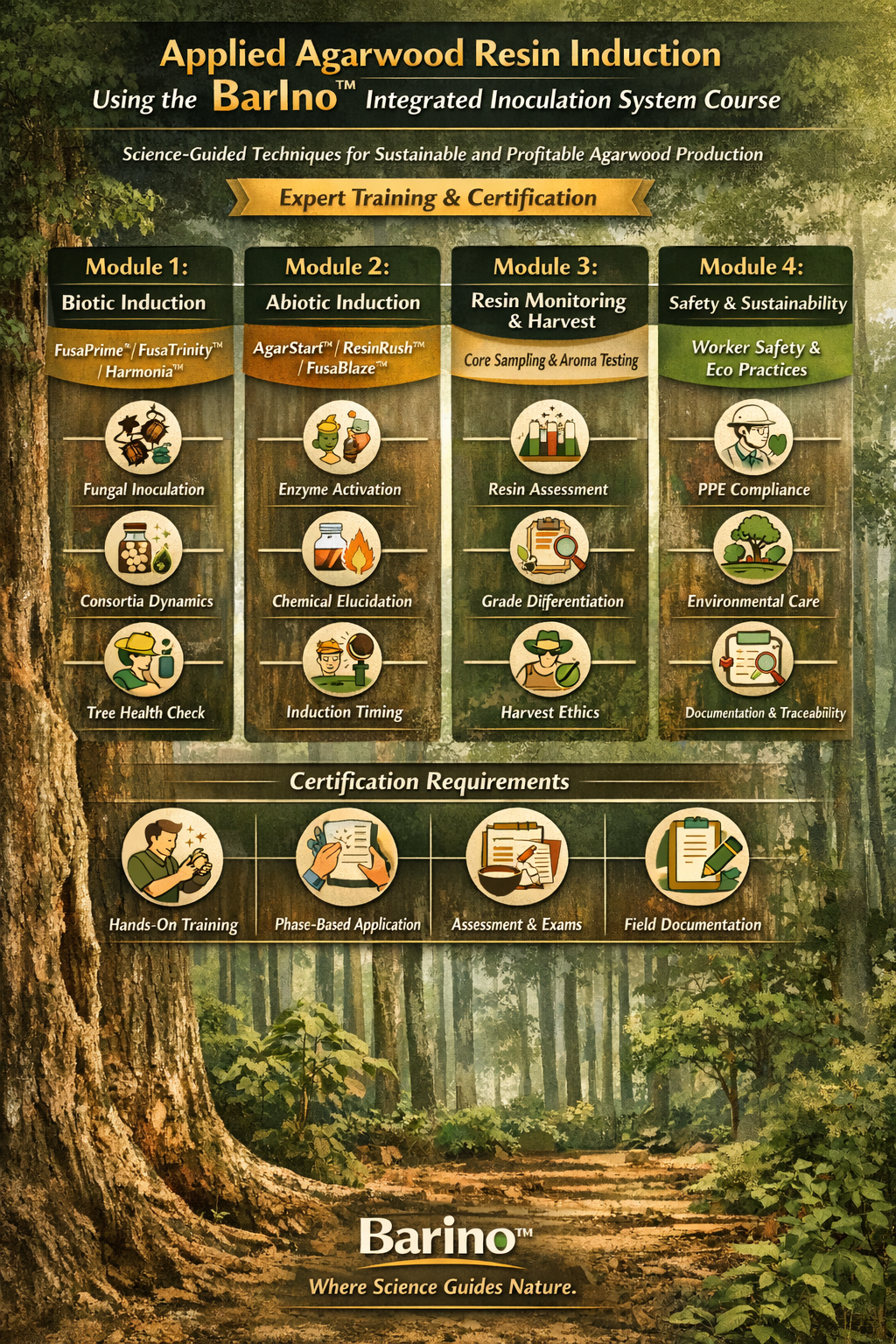
Course Title: Applied Agarwood Resin Induction Using the BarIno™ Integrated Inoculation System
Target Trainees:
- Agarwood farmers & plantation workers
- Forestry technicians & extension officers
- Plantation managers & QC supervisors
- Agarwood consultants & trainers
Course Format:
- Modular (can be delivered as 1-day, 3-day, or 5-day training)
- Classroom + field practicum
- Certification-based
MODULE 1: Foundations of Agarwood Resin Induction (Core Science – Required for All Tracks)
Learning Objectives
- Understand agarwood resin as a plant defense metabolite
- Distinguish biotic vs abiotic induction pathways
- Learn the BarIno™ Sequential Resin Induction Philosophy
Key Topics
- Natural vs induced agarwood formation
- Host–pathogen interaction (Aquilaria defense response)
- Role of stress, oxidation, and microbial signaling
- Overview of BarIno™ product ecosystem
Outputs
- Resin induction flowchart comprehension
- Pre-inoculation readiness checklist
MODULE 2: Tree Readiness & Site Assessment (Critical Control Module)
Learning Objectives
- Identify trees suitable for each BarIno™ product
- Prevent failed or low-resin inoculation
Key Topics
- DBH thresholds & age requirements
- Sap flow, cambium vitality, moisture status
- Seasonal timing (wet vs dry inoculation windows)
- Sanitation & biosecurity protocols
Field Exercise
- DBH measurement
- Tree selection tagging
MODULE 3: Biological (Biotic) Induction – FusaPrime™
Product Focus: FusaPrime™
Learning Objectives
- Understand fungal-triggered resin initiation
- Apply controlled biological stress without tree mortality
Key Topics
- Fusarium-mediated defense signaling
- Colonization vs over-infection balance
- Infection depth, spacing, and density
- Early resin indicators (color, scent, sap change)
Field Practicum
- Drill depth calibration
- FusaPrime™ injection technique
- Infection zone mapping
Expected Outcome
- Resin initiation within 30–90 days
MODULE 4: Chemical (Abiotic) Induction – AgarStart™ & ResinRush™
A. AgarStart™ – Tree Activation Phase
Learning Objectives
- Prime trees for biological receptivity
Key Topics
- Abiotic stress signaling
- Cambial activation and oxidative priming
- When to use AgarStart™ alone vs in sequence
Field Practicum
- Activation hole layout
- Dosage per DBH class
B. ResinRush™ – Resin Amplification Phase
Learning Objectives
- Accelerate resin production post-induction
Key Topics
- Resin flow stimulation
- Oxidative polymerization of sesquiterpenes
- Timing after FusaPrime™ or FusaTrinity™
Field Practicum
- Injection sequencing
- Resin saturation assessment
Expected Outcome
- Faster resin accumulation and darker resin zones
MODULE 5: Dual Induction (Biotic + Abiotic) – FusaTrinity™
Product Focus: FusaTrinity™
Learning Objectives
- Apply synergistic induction for premium-grade resin
- Reduce induction cycles while increasing resin density
Key Topics
- Dual-pathway activation model
- Fungal–chemical interaction control
- DBH-based spacing optimization
- Risk management (necrosis prevention)
Field Practicum
- Single-point dual induction technique
- Density mapping across trunk zones
Expected Outcome
- High-density resin formation with uniform spread
MODULE 6: Fungal Consortium Induction – Harmonia™
Product Focus: Harmonia™
Learning Objectives
- Use multi-fungal ecology to simulate natural forest infection
Key Topics
- Role of fungal succession in wild agarwood
- Cooperative vs competitive colonization
- Long-term resin complexity development
Field Practicum
- Consortium inoculation patterning
- Monitoring colonization balance
Expected Outcome
- Complex aromatic profile suited for high-grade oud
MODULE 7: Microbial Enzyme Induction – FusaBlaze™
Product Focus: FusaBlaze™
Learning Objectives
- Intensify resin density and molecular maturity
Key Topics
- Enzymatic breakdown of lignocellulose
- Enhancement of resin polymerization
- Late-stage induction timing
Field Practicum
- Targeted densification points
- Resin maturity assessment
Expected Outcome
- Heavier, darker, oil-rich resin zones
MODULE 8: Sequential BarIno™ Protocol Integration (System Mastery Module)
Learning Objectives
- Design custom induction programs per plantation goal
Key Topics
- Phase-based induction:
- AgarStart™
- FusaPrime™
- FusaTrinity™ / Harmonia™
- ResinRush™ / FusaBlaze™
- Time-gap management
- Yield vs tree longevity trade-offs
Workshop
- Build a 12–24 month induction calendar
MODULE 9: Monitoring, Harvest Timing & Quality Grading
Key Topics
- Resin maturity indicators
- Core sampling & aroma testing
- Grade differentiation (chips, blocks, oil-grade)
- Harvest ethics & sustainability
MODULE 10: Safety, Compliance & Certification
Key Topics
- Worker safety & PPE
- Environmental safeguards
- Documentation & traceability
- BarIno™ Certified Applicator standards
Final Outputs
- Written assessment
- Field performance evaluation
- BarIno™ Certified Inoculation Technician Certificate